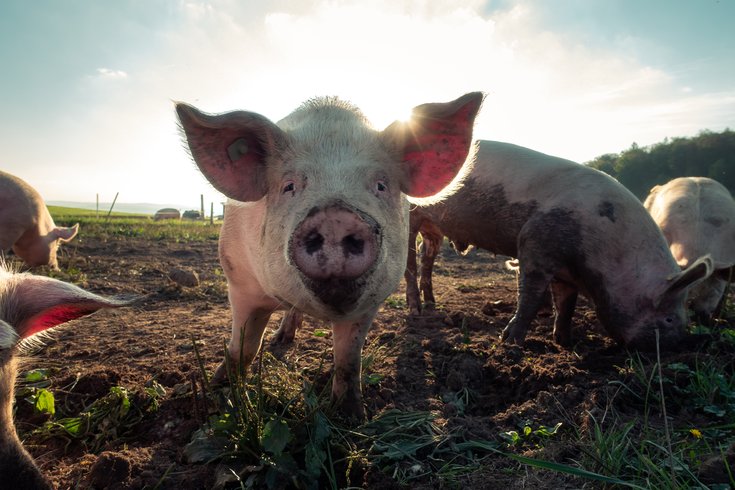
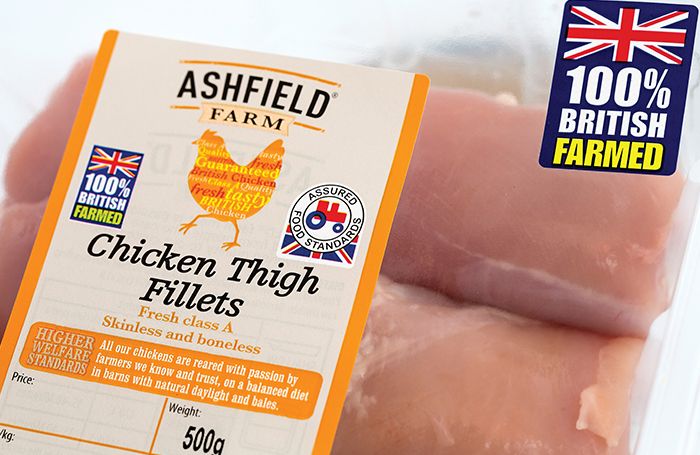
Imagine the scene: You’re rushing around the supermarket trying to find the correct ingredients for your dinner party tonight. You still need to clean the house and have a few hours before your friends arrive. Are you going to raid the meat aisles for farm assurance scheme logos, or will you opt for the first thing you see? Every day consumers are faced with choosing between convenience and ethical standing, and these are just those people who have time to think about animal welfare or the schemes set up to support this.
Farming is a major industry in the UK, with over £5.9 billion spent on fresh meat alone, in 2018 (1). Farm assurance schemes have been set up to help consumers make decisions about the quality of these food products. Broadly speaking they set out criteria around biosecurity, animal welfare and environment that farmers must meet to gain accreditation. Assurance schemes started to pop up following the 1990 Food Safety Act (2); food producers realized they could improve their brand and reputation, especially against competitors in a foreign market, by improving their farming practices and having this recognized (3). Whilst currently only a voluntary measure, these schemes have seen a major welfare change for the millions of animals farmed in the UK each year, with most supermarkets only accepting meat from ‘assured’ farms. Despite this major development for welfare, I have spoken to many people who have never heard of the assurance schemes, let alone tried to understand them.
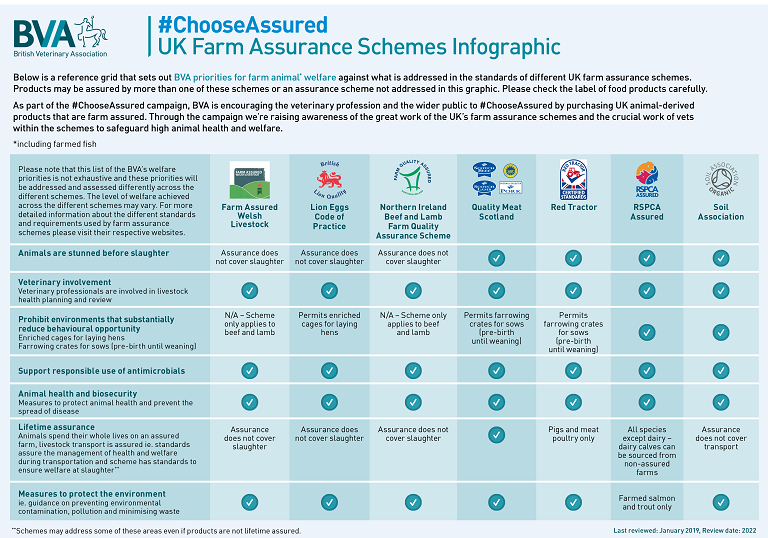
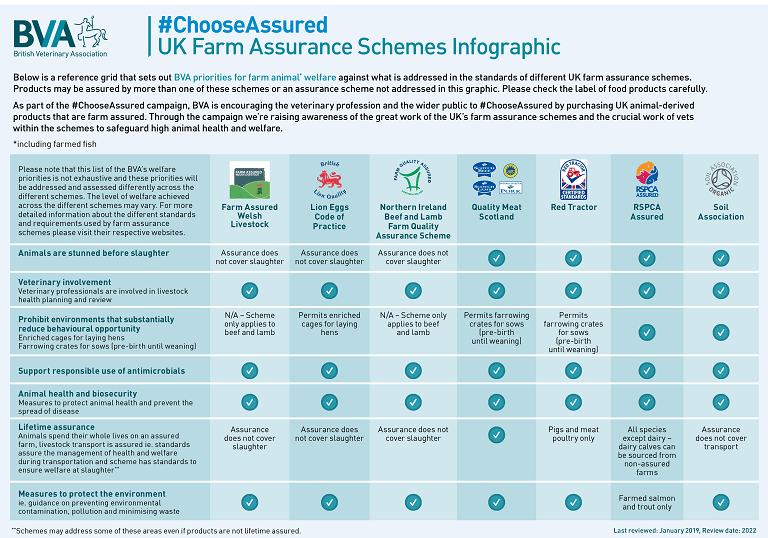
In 2017, as part of their #ChooseAssured campaign, the British Veterinary Association developed a policy position and table breaking down seven UK farm assurance schemes (4) into 7 principles, covering aspects such as welfare at slaughter, use of antimicrobials and animal health. This infographic was the first of its kind to give people a way to understand and compare all current UK assurance schemes and make an informed decision on which scheme most aligns with their priorities when choosing food. In the current climate, with COVID-19 at the forefront of everyone’s minds, this seems like the perfect time to reflect on where our food comes from and engage those who may not have paid attention before. In my opinion, this needs to be led by those who are providing products to the consumer, supermarkets. Supermarkets should be partnering with veterinary professionals to support the #ChooseAssured campaign and make small changes to their aisles, increasing assurance scheme visibility for customers and promoting responsible choices.
Various studies have shown that individuals are becoming more aware of and concerned for the welfare of the animals they consume (5); many believe that measures should be put in place to set higher standards in farming and have stated that they would change their shopping behaviour if it meant a greater quality of life for the animals. However, this belief does not always translate to an actual willingness to pay more money when they are doing their weekly shop (6). There is, however, evidence that making small changes in store, such as moving plant-based burgers to meat aisles, increases the sale of plant-based products (7). Supermarkets already employ various strategies to change behaviour and direct their customers to certain products or offers in store. In a bid to reduce smoking, the UK Government even imposed laws on tobacco products, meaning they had to carry graphic health warnings and not be visible before sale. Why, then, can we not ask our supermarkets to step up and take similar actions in their meat and dairy aisles?
In a world where consumers are bombarded with different products, slogans, and graphics on a daily basis, can we really expect them to make decisions based on time-demanding research? Whilst it would be great if individuals spent time looking out for the welfare levels of their meat, would it not make more sense to place this onus on the producers and supermarkets themselves? As consumers we should expect, and demand, more from the supermarkets that play a large role in the produce we buy. Having clearer placement and labelling on both meat products and the shelves they sit in would support consumers in making up their own mind about the producers they support. Whilst this may not be a popular choice for some producers who do not want their lower quality products overlooked, at what point do we start to value a life worth lived over profits? It is about time supermarkets tried increasing their ethics rather than their margins.
References
- Statista (2021). Supermarket sales value of fresh meat products in Great Britain in 2018. Retrieved from https://www.statista.com/statistics/720712/meat-value-sales-great-britain-uk/ on 26 Oct. 2021.
- UK Public General Acts (1990). Food Safety Act. Retrieved from https://www.legislation.gov.uk/ukpga/1990/16/contents on 01 Nov. 2021.
- Duffy, R., & Fearne, A. (2009). Value perceptions of farm assurance in the red meat supply chain. British Food Journal, 111 (7), 669-685.
- British Veterinary Association (2017). Farm assurance schemes. Retrieved from https://www.bva.co.uk/media/3113/bva-policy-position-on-farm-assurance-schemes-31519.pdf on 26 Oct. 2021.
- Alonso, M. E., González-Montaña, J. R., & Lomillos, J. M. (2020). Consumers’ concerns and perceptions of farm animal welfare. Animals, 10 (3), 385.
- Clark, B., Stewart, G. B., Panzone, L. A., Kyriazakis, I., & Frewer, L. J. (2017). Citizens, consumers and farm animal welfare: A meta-analysis of willingness-to-pay studies. Food Policy, 68, 112-127.
- Piernas, C., Cook, B., Stevens, R., Stewart, C., Hollowell, J., Scarborough, P., & Jebb, S. A. (2021). Estimating the effect of moving meat-free products to the meat aisle on sales of meat and meat-free products: A non-randomised controlled intervention study in a large UK supermarket chain. PLoS Medicine, 18 (7). Retrieved from https://journals.plos.org/plosmedicine/article?id=10.1371/journal.pmed.1003715 on 26 Oct. 2021.
Picture credits
- Organic Pigs. PASCAL DEBRUNNER/UNSPLASH.COM.(2019). Retrieved from https://www.phillyvoice.com/organic-label-guarantee-happy-animal-rights/ on 08 Nov. 2021.
- BVA Farm Assurance Scheme infographic. British Veterinary Association (2017). Farm assurance schemes. Retrieved from https://www.bva.co.uk/media/3768/bva-uk-farm-assurance-schemes-choose-assured-infographic-october-2020-for-web.png on 08 Nov. 2021.
- Example assurance logo. Naylor, G. (2019). Retrieved from https://www.wattagnet.com/articles/37521-uk-farm-assurance-scheme-red-tractor-enacts-tougher-standards?v=preview on 08 Nov. 2021.
 Animal Welfare now